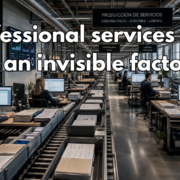
The Professional Services Firm as an Invisible Factory
Time is its raw material
For years, professional services firms have been seen as advisory practices.
And they are.
But they are also something else: service production companies.
They do not manufacture yoghurts.
They do not manufacture cars.
They do not manufacture perfumes.
They produce tax returns, payslips, accounting closings, consultations, management of official requests, meetings, reports, peace of mind and security for their clients.
The difference is that their factory cannot be seen.
There are no machines, no conveyor belts, no warehouses, and no finished products stacked at the end of a production line.
But production exists.
Every day, a professional services firm transforms expert time into services for its clients.
And this is one of the major management keys in the sector: time is the main raw material of a professional services firm.
A factory measures its production. What about a professional services firm?
In any serious industrial company, measuring the cost of production is basic.
It analyses how much it costs to manufacture a product, what materials it consumes, how much time it requires, what machines are involved, which people take part, which processes generate more cost and what margin each unit sold produces.
It would be unthinkable to manage a factory without knowing those figures.
However, in many professional services firms, something surprising happens: client turnover is known, submitted taxes are known, files are known, deadlines are known, prepared payslips are known…
But the real amount of time invested to provide each service to each client is not always known precisely.
And without that data, an essential piece is missing.
Because a professional services firm may know how much it charges a client, but not really know how much it costs to serve that client.
The fixed monthly fee tells you how much you charge. Time tells you how much it costs you to deliver
In the world of professional services firms, many clients work under a fixed monthly fee.
This model has clear advantages: it provides recurring revenue, payment stability and predictability.
But it can also hide an uncomfortable reality.
The fee is fixed.
The work is not.
A client may pay the same fee every month, but consume far more time at certain points of the year: year-end closings, tax campaigns, inspections, official requests, consultations, urgent issues, calls, meetings or corrections.
That is why client profitability cannot be understood by looking at a single isolated month.
You need to look at the full cycle.
Continuous measurement makes it possible to detect deviations throughout the year.
Analysing the full year makes it possible to understand the client’s real profitability.
The key question is not only: “How much does this client generate in revenue?”
The full question is: “What services do we provide to this client, how much time do they consume and what real profitability do they leave us with?”
Without service cost, client profitability is incomplete
Many professional services firms have a reasonable view of their income.
But profitability is not calculated from income alone.
Profitability requires connecting income with costs.
And in a professional services firm, a fundamental part of the cost lies in people’s time.
That is why, if time is not measured by client, action and service, it is very difficult to know:
- which services consume the most resources;
- which clients absorb the most time;
- which actions are repeated too often;
- which tasks should be reviewed;
- which processes need improvement;
- which clients require a review of fees, scope or working method.
Without time data, many decisions are made by intuition.
And intuition can help, but it should not replace reality.
It is not a lack of effort. It is a lack of visibility
In many professional services firms, the problem is not that the team works too little.
Quite the opposite.
The team responds, rushes, solves, handles, reviews, corrects, submits, calls, replies and puts out fires.
The problem is that much of that effort may remain invisible to management.
And when effort cannot be seen, it cannot be properly analysed.
That is when difficult questions arise:
- Why are we so overloaded?
- Which clients consume the most energy?
- Which services should we redesign?
- Which processes should we document?
- Which tasks could we automate?
- Which improvement project would have the greatest impact?
- Which client is truly profitable?
- Which client appears profitable, but is not?
Without data, all those questions are answered with opinions.
With data, they start to be answered with facts.
The improvement roadmap is hidden in time
A professional services firm cannot improve everything at once.
It cannot review all processes, all clients, all services and all tasks at the same time.
It has to prioritise.
And this is where time data becomes strategic.
- If you identify the services that consume the most time, you know where a process improvement may have the greatest impact.
- If you identify the clients that generate losses, you know where to review fees, scope, working method or service level.
- If you identify the actions that are repeated hundreds of times, you know where automation may make sense.
- If you identify internal tasks that consume too many resources, you know where to review organisation.
Continuous improvement stops being a list of good intentions.
It becomes a data-based roadmap.
It is not about improving what makes the most noise.
It is about improving what has the greatest impact.
From recording time to managing better
Recording time should not be understood as an administrative exercise.
Nor as a surveillance tool.
When approached correctly, recording time is a management control tool.
It makes it possible to turn an invisible reality into useful information for better management.
- It is not about controlling people.
- It is about understanding the work.
- It is about protecting the team from invisible overload.
- It is about identifying poorly dimensioned clients.
- It is about detecting services with hidden costs.
- It is about deciding with greater clarity.
- It is about applying common sense with data.
TiempoClic: making the invisible factory visible
TiempoClic was created precisely to solve this problem.
It helps professional services firms record, simply and in real time, which action, client and service each person is working on.
This daily data makes it possible to build a much more powerful management view:
- know the cost of each service;
- know and improve the profitability of each client;
- detect loss-making clients;
- identify services and actions that consume too much time;
- prioritise improvement projects;
- prepare the firm for more data-based management;
- create a solid foundation for future automation and artificial intelligence initiatives.
TiempoClic does not replace the ERP, the tax software, the payroll software or the document management system.
It answers a different question: where is the firm’s time really consumed, and what profitability does that work generate?
First data. Then improvement. Then AI.
Today, many professional services firms talk about artificial intelligence.
And that makes sense.
AI is going to transform the sector profoundly.
But AI needs real data to create real value.
If a professional services firm does not know how much time each service consumes, which clients are more profitable, which processes generate more cost or which tasks are repeated most frequently, AI starts from an incomplete view.
Before automating, you need to understand.
Before asking for artificial intelligence, you need to generate quality data.
And in a professional services firm, an essential part of that data comes from time.
Conclusion
A professional services firm does not need to become a factory.
It already is one.
It is an invisible factory of professional services.
Its raw material is the expert time of its team.
Its production is the services it delivers to its clients.
Its challenge is to know the real cost of that production in order to improve profitability, protect the team and make better decisions.
Unrecorded time disappears.
Recorded time becomes data.
Data becomes costs, margins and priorities.
And well-chosen priorities become improvement.
Know the cost of each service.
Know and improve the profitability of each client.
Define your roadmap with data.